

Chapter: Teaching Russian as a Foreign Language in an International Classroom: Best Approaches, Methods, and Techniques by E. Kaledinova and V. Budykina
The chapter is about teaching business Russian to young adults.
Book: Promoting Diversity, Equity, and Inclusion in Language Learning Environments
Book series: Advances in Educational Technologies and Instructional Design
Publisher: IGI Global (igi-global.com) – IGI Global publishes academic peer-reviewed content.
Indexed in Scopus.
Release Date: June, 2023
https://www.igi-global.com/book/promoting-diversity-equity-inclusion-language/285514
Hardcover
Promoting Diversity, Equity, and Inclusion in Language Learning Environments
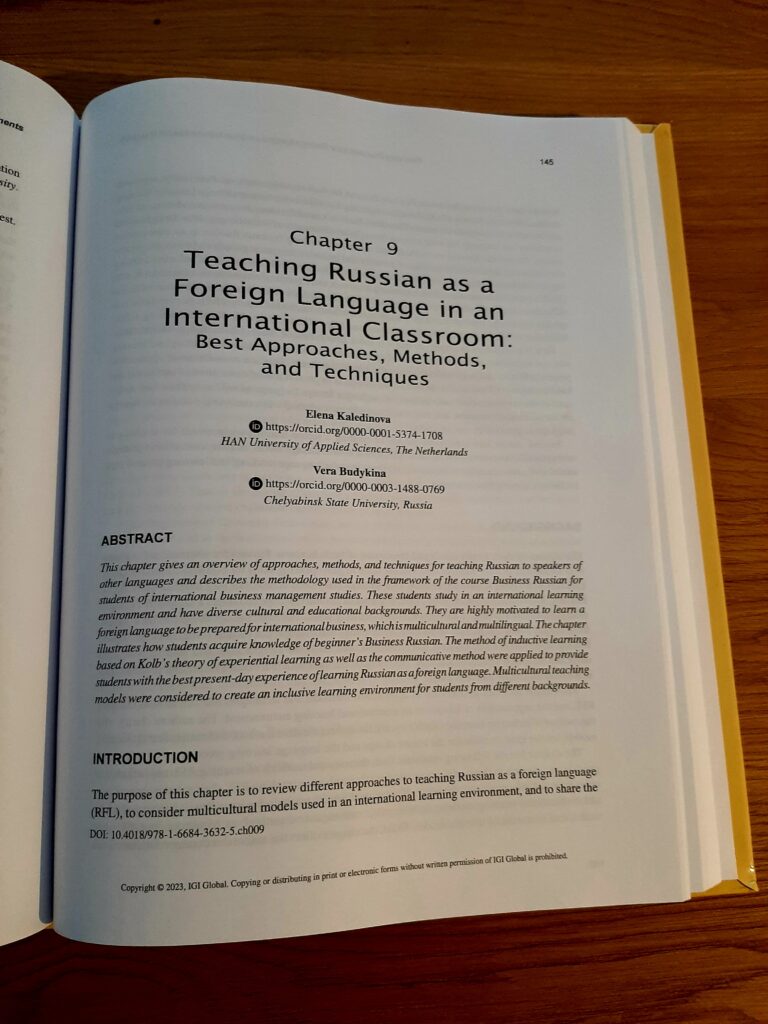
Teaching Russian as a Foreign Language in an International Classroom: Best Approaches, Methods, and Techniques
E. Kaledinova and V. Budykina
Abstract
This chapter gives an overview of approaches, methods, and techniques for teaching Russian to speakers of other languages and describes the methodology used in the framework of the course Business Russian for students of international business management studies. These students study in an international learning environment and have diverse cultural and educational backgrounds. They are highly motivated to learn a foreign language to be prepared for international business, which is multicultural and multilingual. The chapter illustrates how students acquire knowledge of beginner’s Business Russian. The method of inductive learning based on Kolb’s theory of experiential learning as well as the communicative method were applied to provide students with the best present-day experience of learning Russian as a foreign language. Multicultural teaching models were considered to create an inclusive learning environment for students from different backgrounds.
Key Terms
Kolb’s Cycle: The experiential learning cycle is a four-step learning process that is applied multiple times in every interaction and experience. Proposed by D. Kolb in 1984.
Communicative Method: One of the most progressive methods of L2 acquisition. It aims at teaching effective communication while imitating real-life situations in class, thus motivating students to speak actively and select the language structures according to their utility.
Method of Language Acquisition: Method is a mediator between the theory (approach) and practice (technique) in the hierarchy of three concepts used in foreign language teaching: approach, method, and technique.
Learning by Doing: Learning by doing is the process whereby people make sense of their experiences.
Second Language Teaching: The process and study of how to teach a language that is not students’ native.
Approach to Language Acquisition: Approach is the most abstract concept in the hierarchy of three concepts used in foreign language teaching: approach, method, and technique.
Second Language Acquisition: The process and study of how students learn a language that is not their native.
Kolb’s Four Stages of Learning: Experience – Introduction to new knowledge; Reflect – Students examine and identify their own prior experience and knowledge of the topic they are exploring; Think – Students create abstract concepts which can help them to learn a new topic; Act – Students apply the knowledge gained.
International Classroom: A group of students from diverse backgrounds (in culture, education, experience, etc.)
(Teaching) Technique: The narrowest category in the hierarchy of three concepts used in foreign language teaching: approach, method, and technique. An array of techniques may be a part of one method but some of the techniques can develop autonomously.